From Competitor Evidence to an Original Creative Brief
A repeatable method for turning competitor ad observations into a brief your designer can build: separate what you saw from what you infer, filter what transfers, and keep the work original.
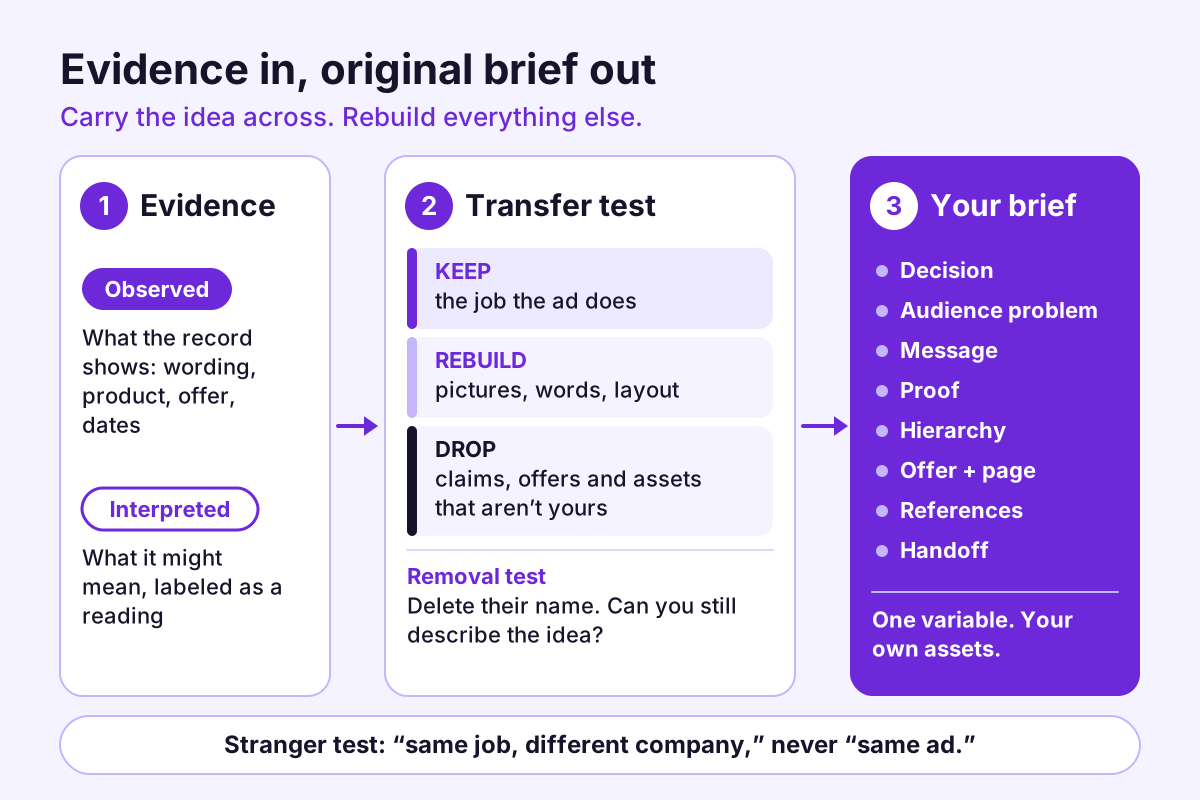
Every team has a folder like this one: forty screenshots, a name like “inspo,” and a Monday meeting where the designer asks the only question that matters. So what are we making? The room goes quiet, because collecting evidence and deciding what to build are different jobs, and the folder only did the first.
This article is about the bridge between them: a repeatable way to turn competitor ad observations into a brief a designer can build from, without producing a lookalike. Every brand, ad and detail in the worked example is invented for teaching, and the method is editorial practice rather than a validated finding.
Evidence says what is out there. A brief says what you will make.
Evidence has one obligation: stay faithful to the record. A brief has a different one: commit to a decision that someone can execute and later judge. When teams skip the translation, one of two things happens. The research stays a mood board with no decision attached, or the “decision” is simply somebody else’s execution with your logo on it.
The fix is not more research. It is a deliberate translation step, and it starts by keeping three kinds of sentences apart.
Keep three kinds of sentences apart
Observed. Something anyone holding the record could verify. “The headline compares the cost of a refill pouch with the cost of a new bottle. The product sits next to an empty bottle. The offer line carries a condition in smaller type.”
Interpreted. A reading of that observation. “This ad may be answering a cost objection rather than an environmental one.” An interpretation is allowed to be wrong, so label it and invite disagreement. Three prompts help: what problem is the ad answering, what proof is it leaning on, and what job is the layout doing?
Decided. What you will do. “We will test a message about effort, using our own photography.”
Only decided sentences give instructions in a brief. Observed and interpreted sentences travel along as references, explaining why an instruction exists. Ad8’s creative reports use the same layering (observation, interpretation, test hypothesis), and the sample report shows how it reads on the page. You can adopt the habit in any document. Labels from a tool, including AI-assisted ones such as a hook type or a visual style, belong in the interpreted column until you have checked them against the record.
The transfer test: what survives the trip
For each reference, sort what you noticed into three bins.
- Carry over: the job. The structure of the argument. The ad names a problem, shows the mechanism and makes the next step look easy. That sequence is a job description, and job descriptions aren’t owned by anyone.
- Rebuild: the surface. Pictures, wording, color, type, props, tone, talent. Rebuild every piece from your own product, voice and assets.
- Drop: what isn’t yours. Another brand’s claims, offers and conditions, its distinctive composition, and anything you don’t own or license. Also drop any claim you can’t support with your own evidence.
Two quick checks catch most problems. The removal test: delete the competitor’s name from your notes and describe the idea in one sentence without describing their picture. If you can’t, you have memorized a layout rather than extracted an idea. The stranger test: lay your draft beside the reference. A viewer should say “same job, different company,” never “same ad.”
A worked translation (invented)
Say you run Brand R, which sells hand soap in refill pouches. The question for the week: should the next static batch explain the refill system, or lead with the saving? You pull three invented reference records from two tracked Pages, A and B, over a 14-day window. Page B’s latest check was partial, so you note that beside its record instead of treating the picture as complete.
| Ref | Observed | Interpreted | Decided |
|---|---|---|---|
| Ref-1 | Headline compares pouch cost with bottle cost; a condition sits in the small print | A value argument with a qualifier | Set aside. Without a verified cost per use, there is nothing honest to say yet. |
| Ref-2 | Close-up of a pouch being poured into a bottle; headline names the step | An effort argument that shows the mechanism | Carry the job. Show our own mechanism, photographed by us, and verify any time claim before it appears. |
| Ref-3 | Shelf photo with a single line about waste; no offer visible | A mood-led values argument | Set aside. With no distinct proof, we would be copying a vibe. |
Notice what the table did. Three references produced one decision and two recorded non-decisions. A brief that can say “considered, set aside, and here’s why” shows that the filtering was real.
The single instruction that came out of it: test a headline that explains the refill step against the headline you run today, with the same product photo and the same offer, so the headline’s job is the only variable. The saving message goes on a parked list with one note attached: it needs a verified cost per use before it can appear in an ad.
How many references belong in a brief?
Fewer than you collected. A useful rule of thumb, again editorial practice and not an empirical finding: a reference earns its place by changing a decision. In the example, Ref-2 changed what you will make. Ref-1 and Ref-3 changed what you set aside, which is worth keeping in your research notes, but the designer doesn’t need to carry them.
The brief, ready to copy
Paste this into your own document. Its fields follow Ad8’s static-ad brief template; answer each in a sentence or two.
DECISION      What we need to learn: ____   The one thing we change: ____
AUDIENCE      The customer's problem, in their words: ____
              Evidence we have: ____   Assumptions to test: ____
MESSAGE       One sentence: ____   Headline direction: ____
PROOF         What shows it is true: ____   Who owns it: ____
              No proof? Drop the claim.
HIERARCHY     First: ____   Second: ____   Third: ____
              Must stay visible: ____
OFFER + PAGE  Our actual offer and conditions: ____   Destination: ____
              Does the page repeat the promise? ____
REFERENCES    Record ID / what we observed / what we infer / coverage notes
              DO NOT COPY: ____
HANDOFF       Assets we own or license: ____   Our measurement plan: ____
              Label: test hypothesis, not predicted winner
The “do not copy” line under references is cheap to write and expensive to omit. It names, in advance, the elements of the references that must not appear in the finished work.
Pre-flight: originality and claims
Before the brief leaves your hands, ask:
- If every reference vanished, would the brief still make sense on its own?
- Is each factual claim backed by something we own, or removed?
- Are the images, type and wording ours, either made in-house or licensed?
- Can we honor the offer as written, conditions included?
- Does the first screen of the destination page repeat the ad’s promise?
- Does the brief name exactly one variable?
- Have we written down what we will do if the result is “no clear difference”?
- Do the references list their limits: partial checks, missing media, old observations?
Access to a record is not permission to reuse it. Seeing an ad in a library or a tool does not give you rights to its images, copy, music or logos, and the brief is where you make that boundary explicit.
Handing it to a designer
A designer can do a great deal with a few sentences of context, three things to look at and one thing to avoid. Walk through the references together for ten minutes, framed as “here is the job each one does,” then close the folder. Ask for two rough thumbnails before anything is polished. If both resemble Ref-2, point to the brief field where they diverge from it.
If a draft comes back uncomfortably familiar, skip the taste debate and ask which sentence of the brief it follows. If the honest answer is “none,” the draft is following the reference, not the brief. The brief is the referee.
Four ways the translation goes wrong
Skipping the interpretation. Going from screenshot straight to layout notes drops the “why,” so the designer reproduces whatever is visible.
Treating frequency as a mandate. “Three competitors do this, so we should” mistakes a pattern in a sample for a performance signal. Samples can be partial, and an ad that has been observed for a long time has not been shown to be profitable by that fact alone.
Over-fitting one record. A single ad is an anecdote. Use it to ask a question, not to settle one.
Inheriting the offer by accident. A reference with a visible discount can quietly become your discount. Offers depend on your margin, fulfillment and terms, so write your own into the brief, even if it is less exciting than what the reference shows.
Where Ad8 fits
Ad8 keeps record references and observation dates with each ad, and coverage notes for each tracked Page and market, so the references field of your brief can be filled from the source instead of from memory. The routine in the weekly competitor review ends in the same place as this article: a small set of original test hypotheses, each traceable to evidence, none presented as a predicted winner. Whether a given test helps depends on your product, your audience and your own measurement.
Sources and further reading
- Ad8 static-ad brief template: the structure behind the brief above.
- Ad8 sample report: a fictional report with observation, interpretation and test hypothesis kept apart.
- Ad8 weekly competitor review: a seven-step routine that ends in a decision.
- Ad8 data coverage and research limits: what timestamps, partial checks and record counts do and do not mean.
- About the Meta Ad Library (Meta Business Help Center) and the Meta Ad Library itself: background on public ad records. Ad8 is an independent service and is not affiliated with or endorsed by Meta.
Turn the next observation into a better question.
See how a source-linked review separates what was observed, what it might mean, and what you could test with your own creative.
Explore the sample report