Why a Long-Running Meta Ad Is a Clue, Not Proof of Profit
A competitor ad that has run for months deserves a look, but it cannot tell you what it earned. Here are seven other explanations, a clue ladder and safer language for your notes.
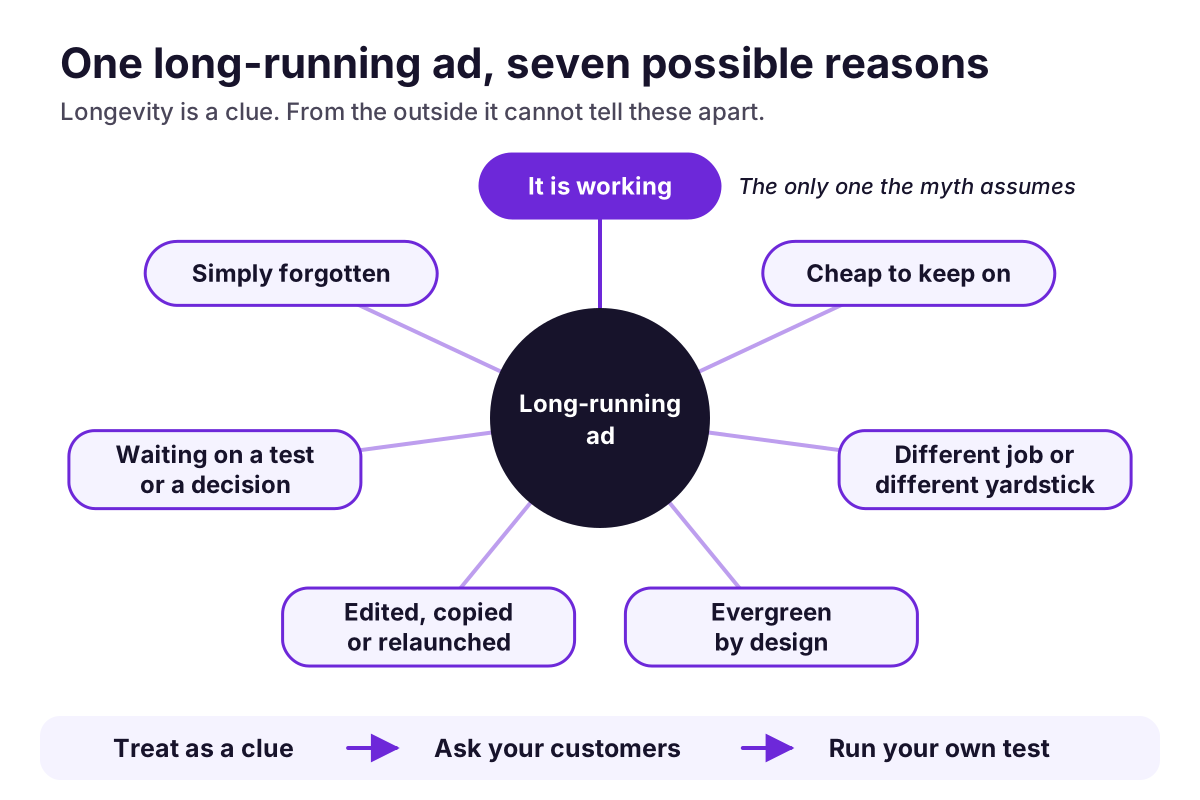
“If it has been running for six months, it must be working.” You have probably heard that sentence in a creative meeting, or said it yourself. The logic feels airtight: nobody keeps paying for an ad that loses money. Open the Meta Ad Library, find something that has been live for ages, and you seem to have spotted a winner that somebody else paid to prove.
It is a good clue. It is not proof, and the gap between those two words is where a lot of competitor research goes wrong. This article takes the inference apart, lists the other explanations you should hold open, shows how to rank clues without dressing them up as results, and ends with note-taking language that stops a hunch from hardening into a “fact”.
The inference you are actually making
Spelled out, the reasoning goes like this:
- The ad has been listed for a long time.
- The advertiser would have switched it off if it were losing money.
- Therefore it makes money.
Each step leaks. Step two assumes someone is watching this particular ad, measuring the right thing and acting on it. It also assumes that making money on this ad is its goal. Step three assumes no other explanation fits, which is exactly what we are about to test. Public data cannot patch these leaks, because the evidence that would (spend, conversions, margins, customer value) lives inside the advertiser’s own accounts.
Seven explanations for a long-running ad
Hold these open every time. From the outside, most of them look identical.
- It is cheap to keep on. A small budget can run for months without anyone looking at it.
- It has a different job or a different yardstick. An ad can aim at awareness, sign-ups or a long customer relationship, and the advertiser may judge it by something you cannot see.
- It is evergreen by design. A plain product explainer may be left alone because refreshing it costs effort and nothing is obviously wrong.
- The listing is not the idea. A date describes one listing. The ad may have been edited, duplicated, paused or relaunched in ways public records do not show.
- It is waiting on a test or a decision. Someone may be collecting data, holding a control, or waiting for the quarterly review.
- It was forgotten. Ad accounts collect leftovers, and nobody switches off what nobody opens.
- It is working. Entirely possible, and the only one the myth assumes.
Seven candidates do not mean the odds of profit are one in seven. They mean the observation alone cannot rank them, and honest notes say so.
Fair is fair: longevity still earns attention
None of this makes longevity worthless. An ad that has persisted is, on balance, more worth a look than one that appeared and vanished within days, if only because someone has had many chances to turn it off. The right response is to raise its priority, not your confidence. Longevity tells you where to point your curiosity. It cannot tell you what you will find when you get there.
What a public library cannot show
Survivors, mostly. Meta’s help page describes the Ad Library as containing active ads, with some categories and regions kept beyond that, so check the current scope. In an ordinary search you therefore meet ads that are still running, not the ones switched off quietly last month. With the stopped ads out of view, you cannot work out how often long-running ads succeed. There is no denominator.
Private results. Conversions, return on ad spend, margins and customer value are not in the library. Meta publishes extra transparency detail for some ad categories and regions, so check its help page, but nothing there tells you whether an ad was profitable. Ad8’s coverage page is equally plain that it does not turn public creative records into verified spend, ROAS, conversions or profitability.
Four different dates. “How long has it been running?” can mean several things. A source-reported start date answers one question. First observed (when a collection first saw the record), last observed and last checked answer others. “Observed for 90 days” and “running for 90 days” are different statements, and a tool can vouch only for the first.
A habit that helps: before you quote any duration, write which date you mean. If the earliest date you have is simply the day your tracking began, say “observed since”, not “running since”. The first is a fact about your window. The second is a claim about the advertiser.
A worked comparison (illustrative)
Invented for this article: a rival studies Demo Sleep, a fictional mattress-topper brand. Two items stand out.
- Ad X: one static image and headline, shown with a start date about 190 days before the check, no visible change since.
- Ad Y: a cluster of nine static records sharing one message (“cooler nights”), first observed across eleven weeks, the newest 12 days old, all still present at the latest check.
Which is the stronger clue? Not the older one. Ad X shows that one listing has persisted, and explanations 1, 3, 5 and 6 fit it as well as success does. Ad Y shows something more deliberate: somebody keeps producing fresh executions of one message, week after week. That is better evidence that the advertiser pays attention to the message. It still says nothing about whether the attention pays off.
So the output is a reading order, not a verdict: study Ad Y’s message first and keep Ad X as background.
The logic cuts both ways. Suppose a third ad, Ad Z, appeared for nine days and was gone. That is not a failure either. A planned campaign flight, a seasonal promotion, a stock-out or a swap to fresher creative can each end an ad that did exactly what it was meant to do. Short-lived ads deserve the same humility as long-running ones: record what you saw and resist the story.
A clue-strength ladder
This ladder is an editorial heuristic, not a measured scale. It ranks signals by how plausible they make deliberate attention, not profit:
- Still listed at the latest check. Weakest. It fits every explanation above.
- Listed across a long span. Slightly stronger, subject to the date caveats.
- The message returns in fresh executions. Someone is investing creative effort.
- The message appears across several of the advertiser’s Pages or markets. More than one team or region chose it, though they may simply be reusing one asset.
- The offer or proof is updated while the core message stays. Someone is maintaining the argument rather than leaving it on.
Even rung five proves nothing about profit. Use the ladder to decide where to look first, never to score a winner.
Say this, not that
- Not “winning ad”. Say: “still listed at our latest check; first observed on [date].”
- Not “proven angle”. Say: “message recurs in [n] of [N] sampled records.”
- Not “they scaled it”. Say: “more records observed in this window; reason unknown.”
- Not “it’s profitable”. Delete the sentence. You do not know.
If someone asks, “Is it a winner?”
Stakeholders want a verdict, and “we can’t know” sounds like a shrug. Give them three sentences instead. Here is what we can see: “The message has recurred in nine records over eleven weeks.” Here is what we cannot: “Spend, results and the advertiser’s goal.” Here is what we will do: “Test our own version of the underlying idea with our own measure.” The answer is honest, specific and ends in action, which is more useful than a confident guess.
What to do with a clue
Turn it into a question about your own customers rather than a copy decision. If a rival keeps iterating on “cooler nights”, ask whether your reviews, support questions and search terms mention temperature at all. Your own evidence can strengthen or sink the idea long before you spend on creative.
If it survives, write an original test with one variable and a measure from your own data. The static ad brief template has the fields, and the weekly review template shows where a clue log fits in a routine. Log each clue honestly:
CLUE LOG
Observation:        [what is visible, with record reference]
Ladder rung:        [1 to 5]
Rival explanations: [at least two from the seven]
Change my mind:     [what we would need to see]
Our test:           [one variable, our own measure]
Notice what the log has no field for: a verdict on the competitor’s profit. That omission is deliberate.
Where Ad8 fits
Ad8’s reports are designed to treat longevity, repetition and variant count as observable signals, not scores. They sit alongside observation dates and coverage notes, and each report says plainly that none of this is spend, conversions or profit. Ad8 does not label a competitor ad a “winner” on those signals alone (creative reports), and it works from public ad records, not from anyone’s ad account. The sample report shows the format: observation, interpretation and test hypothesis kept apart.
Sources and further reading
- About the Meta Ad Library (Meta Business Help Center): what the library includes and for how long. Scope can change, so check the current page.
- Meta Ad Library: the public search interface. What it shows depends on when you look.
- Data coverage and research limits: the difference between source-reported, first-observed, last-observed and last-checked dates.
- Creative reports: how Ad8 frames longevity and variant signals.
- Sample report: a fictional report with evidence, interpretation and hypotheses separated.
- Understanding your report: reading alternative explanations for apparent change.
- Weekly competitor review template
The Demo Sleep ads are invented for illustration. The ladder and the clue log are working heuristics from Ad8’s editorial desk, not measured findings.
Turn the next observation into a better question.
See how a source-linked review separates what was observed, what it might mean, and what you could test with your own creative.
Explore the sample report