The 45-Minute Competitor Ad Review That Ends With a Test, Not a Screenshot Folder
A weekly competitor ad review works better with a clock. Five timed blocks take you from a coverage check to one test card with a proof line and a decision rule.
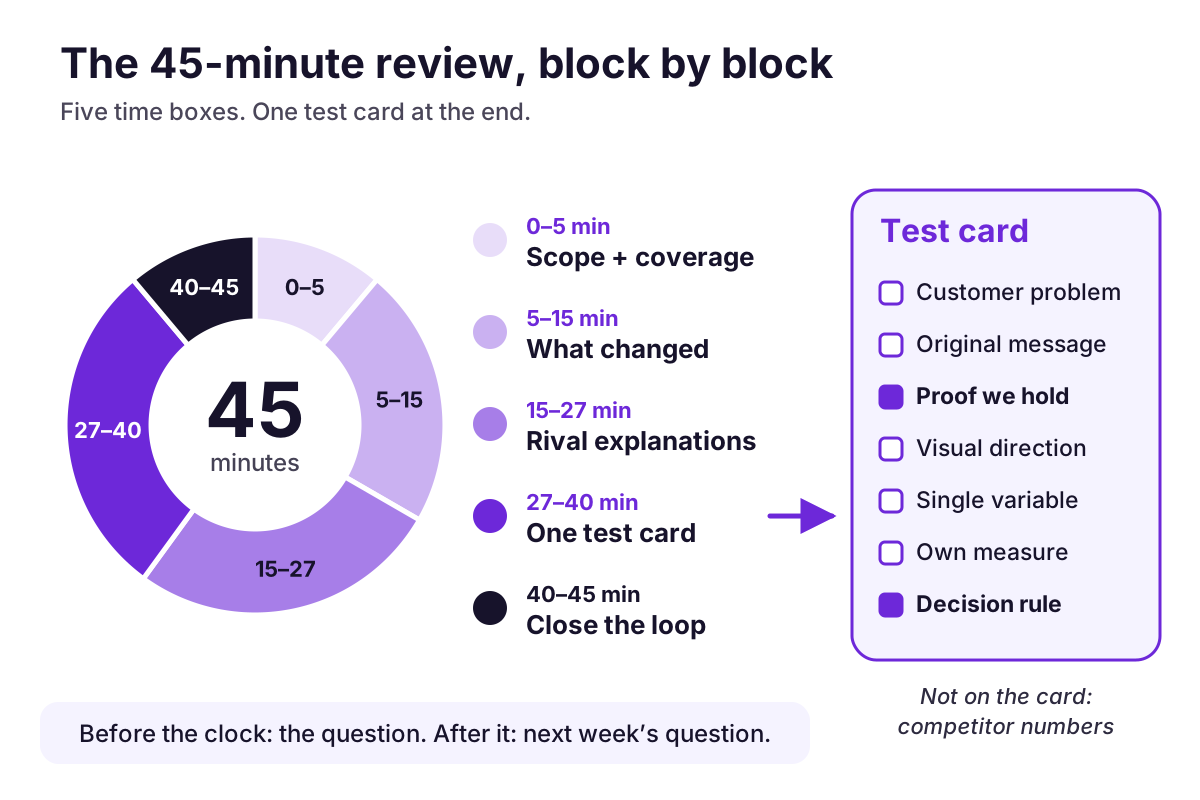
Most weekly competitor reviews fail in one of two ways. They sprawl until somebody has to leave for another meeting, or they end tidily with “I’ll put the links in the folder.” Either way the output is the same: a pile of examples and no decision.
The fix is boring and effective: a clock. Forty-five minutes is long enough to look properly and short enough that nobody can wander. This run sheet builds on Ad8’s weekly competitor review template. It turns the template’s seven steps into timed blocks, shows a worked week (invented for illustration), and ends with two cards you can copy.
Before the clock starts: one sentence
Whoever runs the review writes the question in advance:
This week we need to understand ___ so we can decide ___.
“See what competitors are doing” fails because nothing can answer it. “Are the three closest Pages leading with fit or with price, so we can choose the headline variable for next week’s static batch?” works because a table can answer it. The last block of the review sets next week’s question, so nobody starts from a blank page.
What to bring
- The question, written in advance.
- Last week’s test card, with its decision rule.
- The Pages and markets in scope, with each check’s status and time.
- A one-page sheet of verified product facts, so proof lines can be checked on the spot.
- A timer that everyone can see.
Minutes 0–5: Check the ground you are standing on
Before you look at a single ad, write the scope on one line: which Pages, which markets, which dates, and anything stale. In Ad8 each Page-and-market check carries a state (checked, partial, pending or unavailable) plus a last-checked time. Working by hand in the Meta Ad Library, your equivalent is the day and market you searched. If you lean on a weekly digest, remember that it summarizes the latest available observations; it does not imply every Page was rechecked in the past seven days.
Then apply one rule: a Page whose check is partial, pending or failed is not compared this week. It gets a flag. “Nothing new from Page C” means nothing if the check never finished, and an incomplete check must never be read as a clean zero.
Finish the block with last week’s card. Read its decision rule aloud. If the test has run, apply the rule to your own results and record the outcome in one line. If it has not run yet, say so and move on. A review that quietly forgets its own homework teaches the team that the card does not matter.
Minutes 5–15: Open what changed, and only that
Ten minutes, timer visible, no analysis yet. Open the newly observed records for each in-scope Page and capture at most three observations, each with a record reference. An observation is something you could point at: “Four new static records from Page A; three include a cup-holder line,” or “Page B shows a two-bottle bundle; conditions are not shown.”
Hold one distinction firmly: newly observed means new to the collection in the window you are viewing. It does not mean first launched that day, a point Ad8’s tracking pages make too. Done by hand, the same caution applies: your first sighting is not their launch.
Wording matters here, because loose phrasing hardens into belief by the next meeting. Three swaps help:
- “Page B is pushing bundles hard” becomes “Page B shows a two-bottle bundle in one newly observed record.”
- “Page A changed its strategy” becomes “Page A has four newly observed records that were not in last week’s window.”
- “Page C went quiet” becomes “Page C’s latest check was partial, so there is nothing to compare.”
Each swap trades a verdict for something you could point at, which is the whole job of this block. If something deserves a deeper hunt, it goes in the parking lot. Rabbit holes are for after the review.
Minutes 15–27: Pair every observation with a rival explanation
This block stops a neat story from outrunning the evidence. For each of your observations, someone (the skeptic, see below) writes at least one competing explanation. Typical candidates:
- The records are variants of one idea, not several ideas.
- The offer has been live for a while and was only collected recently.
- A catch-up collection or a previously incomplete check created an apparent surge.
- Visible longevity says nothing about spend or results.
The skeptic’s script is three questions. What else could explain this? What would we expect to see if that explanation were true? Can we check it in two minutes, or does it become next week’s question? Often the check is as simple as reading the record’s observation dates or the Page’s coverage state, and that alone can dissolve a neat story.
Then decide which observations survive. “Survive” means three things: the observation holds up against its rival explanation, it applies to your product, and it points to a variable you can actually test. Cross out the rest. Crossing out is progress.
Minutes 27–40: Write one test card
Choose one idea. Not three, one. The card has seven fields, and nobody leaves the room with a blank:
TEST CARD
Customer problem:  [plain language, from our own evidence]
Original message:  [one sentence, ours]
Proof we hold:     [spec, demo or permission; if none, drop the claim]
Visual direction:  [what is noticed first, second, third]
Single variable:   [the one thing that differs between versions]
Own measure:       [metric from our own systems, chosen now]
Decision rule:     [if X, we do Y; otherwise we do Z]
Two fields do the heavy lifting. The proof line kills any idea that depends on a claim you cannot substantiate, and the decision rule stops you moving the goalposts after results arrive. Notice what is absent: competitor numbers. Another advertiser’s ad count or run time is never your success criterion. Your own results decide whether the test worked.
A decision rule can be short. For example: “If the specific headline beats the generic one on our chosen metric by more than the week-to-week wobble we normally see in our own account, it becomes our default lead. If the gap sits inside that wobble, we keep both and test the proof line next.” Whatever you write, write it before the test runs.
When the card exists, the static ad brief template turns it into a designer-ready brief.
Minutes 40–45: Close the loop
Three jobs in five minutes. Write the conclusion (“We observed ___. The uncertainty is ___. We will test ___ against ___. We will evaluate it using ___.”). File the supporting records next to it. Write next week’s question. Anything left in the parking lot becomes a candidate for that question, not a reason to overrun.
A worked week (illustrative)
Invented for this article: Demo Bottle, a small reusable-bottle brand, reviews three competitor Pages. Nothing here is real data.
Question: Are Pages A, B and C leading with fit or price, so we can
          choose next week's headline variable?
Scope:    3 Pages, 1 market, static only. C's check was partial, so
          C is flagged and not compared.
Observed: (1) A: 4 new static records, 3 with a cup-holder fit line.
          (2) B: two-bottle bundle, "Pair for less"; terms not shown.
Rival:    (1) The 4 records may be one idea in four variants.
          (2) The bundle may be older than our first sighting.
Chosen:   (1). It survives its rival and we can test it.
          (2) is dropped: terms unknown, and we will not guess them.
Test:     Headline "Fits your cup holder" vs "Fits anywhere". Same
          photo, same layout. Proof: our verified base diameter.
          Measure: the metric we pick now. Rule: if the specific
          line does not beat the generic one, stop leading with fit.
Next:     What proof sits next to a fit claim in the sampled ads?
Notice how little of the output is about what competitors do. Most of it is what we will do, and what would change our minds.
Solo, as a team, or in a quiet week
Solo: wear three hats in sequence, with a timer for each. Finish the observations before you put on the skeptic’s hat. A team of three or four: one person keeps time and notes, one plays skeptic, one owns the decision. Rotate the roles weekly so nobody gets stuck defending the same position. A quiet week: if nothing changed, spend the clock on the question itself. Was it sharp enough? Do the Pages and markets you follow still match the decisions you actually make?
If you only have 20 minutes
Shrink the scanning, never the thinking. A 20-minute version keeps a two-minute scope check, a five-minute scan capped at two observations, a five-minute rival-explanation pass and an eight-minute test card. What you must not cut is the rival-explanation block or the decision rule, because those are the two parts that separate research from collecting. If the week gives you less than 20 minutes, skip the review and spend the time sharpening next week’s question instead.
What blows the 45 minutes, and the fix
- Hunting for “just one more” ad. Fix: the parking lot, plus a rule that new searches happen after the review.
- Debating interpretation forever. Fix: write both readings down and move on to the rival-explanation block.
- Wordsmithing creative in the room. Fix: the card names the variable. The writing happens afterwards.
- Calling something a winner. A long-running or repeated ad is something you saw, not something proven. Fix: use the word “observed”.
Sources and further reading
- Weekly competitor review template: Ad8’s seven-step version, which this run sheet expands into a clock.
- Static ad brief template: turns a test card into a brief.
- Data coverage and research limits: coverage states and what each timestamp means.
- Sample report: a fictional example of the write-up a weekly review can feed.
- Competitor tracking: what “newly observed” does and does not mean.
- Creative reports: how weekly digests and on-demand reports differ.
- Meta Ad Library: the public search interface, for reviews done by hand.
The Demo Bottle week is invented. The run sheet is Ad8’s editorial practice rather than a tested standard, so adapt the timings to your team and your category.
Turn the next observation into a better question.
See how a source-linked review separates what was observed, what it might mean, and what you could test with your own creative.
Explore the sample report