Read the Offer Behind the Ad: A Practical Guide to Competitor Promotion Research
A 25% headline is not automatically a bigger offer than 20% or 15%. Read an offer in six parts, keep the wording and the unknowns, and turn the comparison into a creative test.
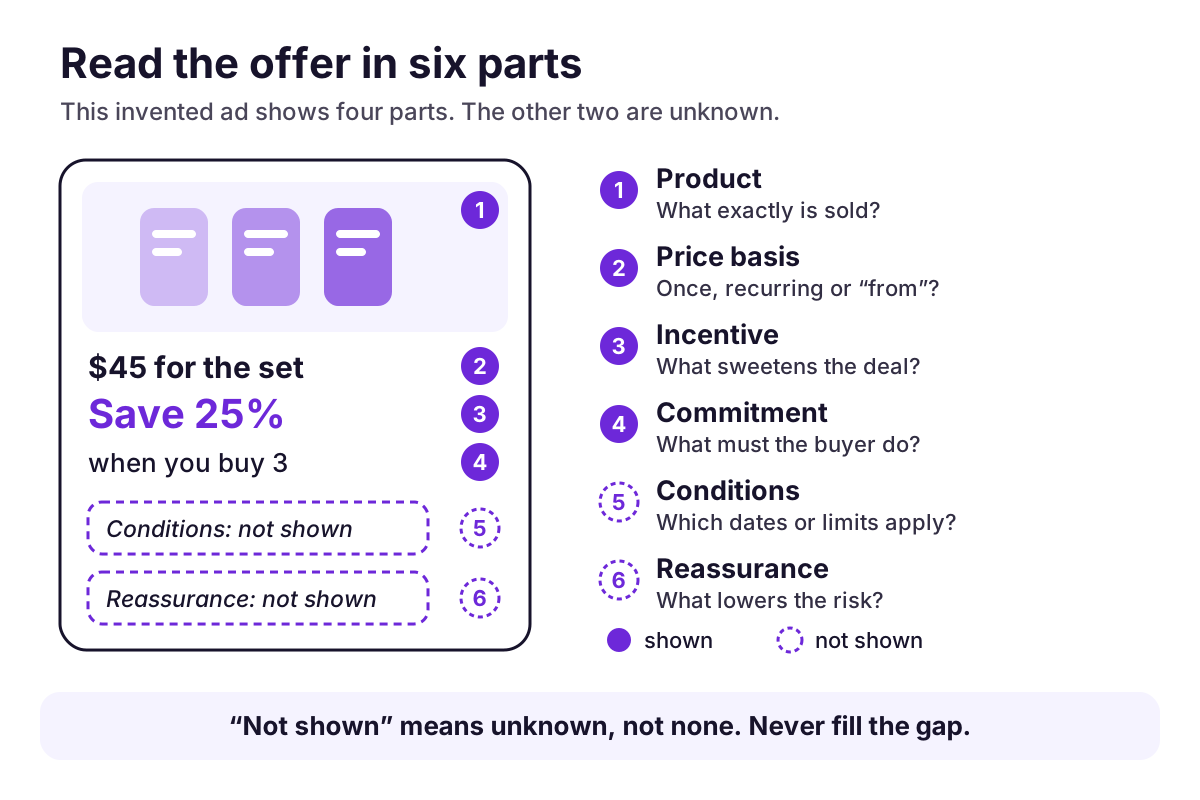
“20% off.” “Buy 3, save 25%.” “Subscribe and save 15%.” Line them up and it is tempting to crown the 25% ad as the most generous and move on. But those three headlines answer different questions. One discounts a first purchase, one asks for a bigger basket, one asks for a standing relationship. Comparing the percentages is like comparing a sale price, a wholesale price and a membership fee because each of them contains a number.
Competitor promotion research is the habit of reading the offer behind the ad: what is actually being proposed, on what terms, and how the creative presents it. Done well, it gives you better questions for your own offer discussion. It cannot tell you what a competitor earns, and it cannot tell you what you can afford. This guide shows how to pull an offer apart, compare three invented examples with real arithmetic, and turn the result into a creative test.
The six parts of an offer
Every offer in an ad can be read as six parts. Record each one, and write “not shown” when the ad does not say.
- Product: what exactly is sold: one item, a pack, a set, a size?
- Price basis: a one-time price, a recurring price, or a “from” price?
- Incentive: the sweetener: a discount, a gift, free delivery, a bonus item, a bigger pack.
- Commitment: what the buyer must do to get it: spend a minimum, buy several, subscribe.
- Conditions: dates, exclusions, regions, stock limits, first-order-only rules and any other terms shown.
- Reassurance: anything that lowers the risk of buying, such as a return window, a trial or a cancellation promise.
The first four decide what the offer is. The last two decide how safe it feels. An ad that shows an incentive but no commitment, conditions or reassurance has told you a fraction of the story.
What each common shape asks of the buyer
- First-order discount: asks for nothing beyond being new, and reaches each customer once.
- Bundle or multi-buy: asks for a bigger basket in exchange for a lower price per unit.
- Subscription: asks for repeat deliveries, so cancellation terms matter as much as the discount.
- Free delivery threshold: asks for a minimum spend, and the saving is on delivery rather than on the product.
- Gift with purchase: adds an item rather than lowering the price, so its value is a judgment call.
Two ads can share a headline number and still ask completely different things of the customer. That is the whole reason to read them in parts.
Keep their words
Preserve the wording exactly as shown, because the small words carry the terms. “From $18” and “$18” are different offers. “Up to 40% off” and “40% off” are different offers. “First order”, “selected items”, “while stocks last” and “subscription” each change who can use the offer and how often. Paraphrasing “up to 40% off” into “40% off” in your notes is how a hedged claim becomes a bold one.
A quick mismatch check helps too. Suppose an ad headlines “From $18” while the image shows a $38 set. The price basis is “from”, the product shown is a set, and the two do not obviously match. Record both exactly as they appear and add a note: headline price and pictured product may refer to different items. Do not settle the question by guessing which price the buyer pays.
Four more traps catch careful people:
- Percent versus amount. “Save 25%” and “save $5” are different claims. Convert one into the other only when both the base price and the pack are shown.
- Stacked wording. “Extra 10% off” assumes another discount you may not be able to see.
- Terms inside the image. Fine print can live in the pixels rather than the copy field, so read the picture as well as the text.
- Region. A price or threshold shown in one market says nothing about another.
Worked example: three ads, three kinds of “discount”
Illustrative example, invented for this article. Assume a 340 g bag of coffee with a list price of $20 at three fictional brands.
- Brand A: “20% off your first order.”
- Brand B: “Buy 3, save 25%.”
- Brand C: “Subscribe and save 15%.”
Laid out by the parts of the offer, with the arithmetic done:
                 A: first order   B: buy 3         C: subscribe
Headline         20% off          25% off          15% off
Pay today        $16 for 1 bag    $45 for 3 bags   $17 for 1 bag
Price per bag    $16, once        $15              $17, each delivery
Commitment       none shown       a $45 basket     repeat deliveries
Conditions       "first order"    none shown       not shown
The biggest headline (B, 25%) has the lowest price per bag and the highest cash outlay. The smallest headline (C, 15%) is the only one that discounts every delivery. Brand A has the lowest entry price and the narrowest reach, because only the first bag is cheaper. Which is “best” depends on the question: entry price, unit price or an ongoing relationship. Brand C also leaves its cancellation terms out of the ad, so the honest entry is “not shown”, not “easy to cancel”.
Note what the table cannot tell you: any brand’s margin, how many people take each offer, or why each brand chose its shape. Those answers live in the advertisers’ own books.
What the offer is doing in the creative
An offer can be the message, a supporting detail or fine print, and that choice is itself a creative decision worth recording. For each ad note the offer’s prominence: lead (it is the headline), support (a badge or subhead) or fine print. Then ask whether the creative explains the offer or just shouts it. A set shown with its contents laid out is doing a different job from a number on a red circle. Ad8’s sample report illustrates the distinction with fictional records: an ad can carry a bundle offer while its message is a morning routine.
Reading change over time
When the same Page shows a different offer in a later window, resist the headline “they changed their offer”. First ask whether the incentive changed or only its presentation: one bundle can be framed as a saving in one ad and as a set in another. Then ask whether the earlier window was fully checked. A newly observed record is new to your collection, not necessarily new to the market, a distinction Ad8’s tracking pages make too. And limited-time wording such as “ends Sunday” tells you what the ad said, not when the offer really ended. Record the dates you have and leave the rest unknown.
Unknown is a valid entry
Most ads leave something out. Write “not shown”, never a guess, and remember that “terms not shown” does not mean “no terms”. An ad is a claim made in a small space. The landing page may add conditions the ad omitted, and checkout can differ from both. If you do look at a landing page, log it as a separate observation with its own date, because it is a different source. Ad8’s offer research workflow compares visible advertising claims and does not verify prices or terms at checkout. Your notes should be just as modest.
The offer record
One short record per ad keeps the six parts together:
OFFER RECORD
Record, Page, market, date looked:   [ ]
Product or pack shown:               [ ]
Price basis (once, recurring, from): [ ]
Incentive, in the ad's words:        [ ]
Commitment implied:                  [ ]
Conditions shown:                    [ ] or "not shown"
Reassurance shown:                   [ ] or "not shown"
Offer prominence:                    lead / support / fine print
When you tally the records, keep the denominator and the unknowns visible. “Of 40 records, 11 show bundles and 6 do not state their terms” (invented numbers, used only to show the format) tells the reader how much you know. A count of offers with no count of unknowns overstates it.
From their offer to your decision
Separate two questions that usually arrive tangled. Communication: how should we present the offer we already have? Economics: should we change the offer at all? Research on public ads can inform the first and frame the second, but your own numbers decide the second. Before borrowing any offer shape, check it against your margin after discount, shipping and returns, your fulfillment capacity, and what it might do to repeat purchase. Promotional claims such as “was/now” pricing, urgency messages and subscription disclosures are regulated differently in different places, so get your own legal review rather than assuming a competitor’s wording is safe to echo. And never inherit another brand’s discount or promise just because you saw it.
Test the framing before the discount
Before you test a deeper discount, ask whether a clearer presentation of the offer you already have would answer the same question. Hold the offer, price and product image constant and change one thing: whether the ad leads with the saving, the contents or the condition (“Spend $45, delivered together”). Write it up using the offer and call-to-action fields in the static ad brief template, and judge it with your own results. If the test is inconclusive, you learned something cheaply. If it moves your measure, you have a reason to open the economics conversation.
Sources and further reading
- Offer and promotion research: comparing the value messages visible in collected ads, with conditions kept attached.
- Sample report: a fictional report in which a bundle is the offer but not always the message.
- Static ad brief template: the offer and call-to-action field for original briefs.
- AI research prompts: includes a prompt for comparing offers with their conditions.
- Data coverage and research limits: what a collected ad record can and cannot show.
- Weekly competitor review template: where an offer comparison fits in a routine.
- Meta Ad Library: the public search interface for viewing ads and their visible copy.
The Brand A, B and C ads, prices and tallies are invented for illustration. The six-part reading is Ad8’s editorial practice, and your own margins and results decide which offers are worth making.
Turn the next observation into a better question.
See how a source-linked review separates what was observed, what it might mean, and what you could test with your own creative.
Explore the sample report