Hooks Are Not Angles: How to Find a Message Worth Testing
A question, a comparison and a customer quote are hooks. The reason to buy underneath them is the angle. Learn to sort competitor ads by angle and pick one candidate worth a clean test.
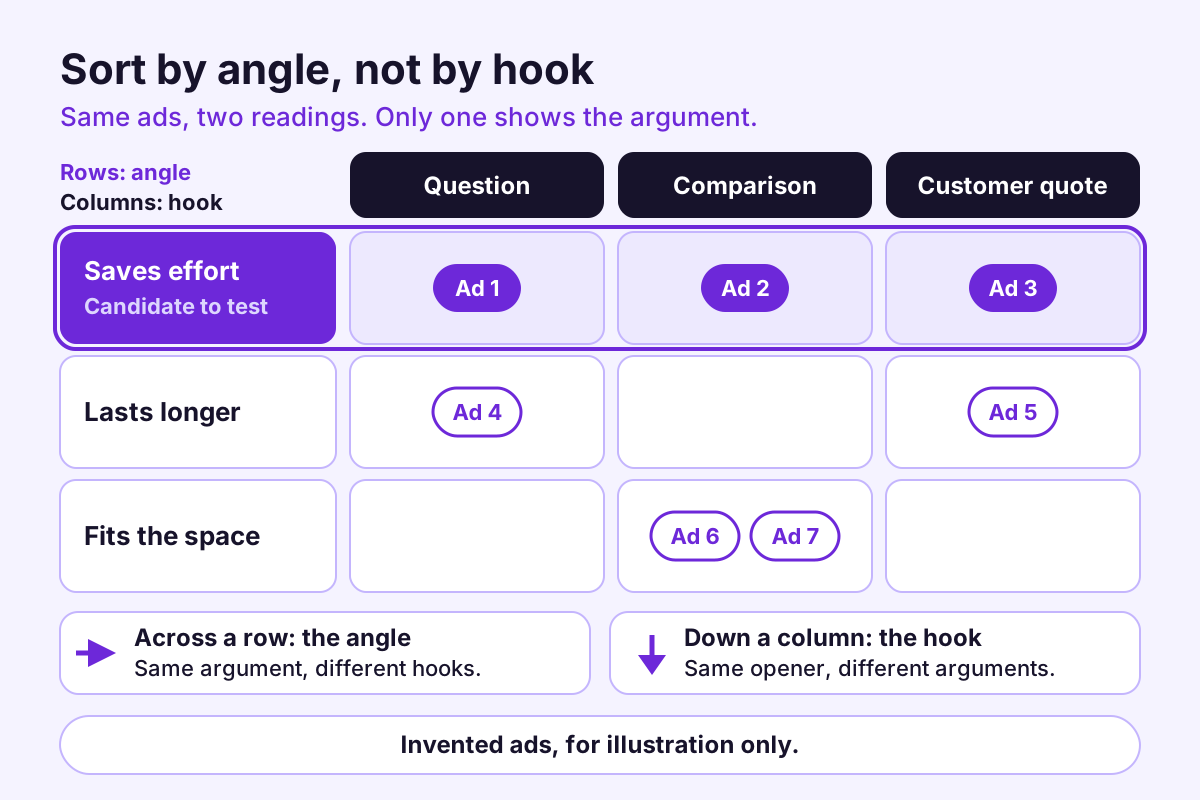
“Their hook is a question.” It sounds like an insight. It is the start of one, and for many teams it is also where the research stops: a spreadsheet of hook types, a slide that says “questions and comparisons are popular,” and a new batch of ads that opens with a question and says exactly what the old batch said.
A hook is how an ad opens. An angle is what it argues. Mixing the two up is an easy way to produce a creative batch that looks varied and tests like a single idea. This article shows how to pull them apart in competitor research, and how to choose a message worth a clean test.
Four layers inside one ad
Take any static ad and you can usually find four separate decisions:
- Angle. The reason to buy: which customer problem the ad names, and why this product is the answer.
- Hook. The first device that earns attention: a question, a comparison, a number, a customer quote, a demonstration.
- Format. The container: a quote card, a split image, a screenshot, a product on a plain background.
- Offer. The purchase invitation: a price, a bundle, a trial, a delivery promise.
The layers are independent. You can keep the angle and change the hook, the format and the offer, or the other way around. That independence is exactly why counting any single layer misleads.
Here is a quick way to separate hook from angle. Swap the opening line for a different device and ask whether the argument has changed. If the argument survives, you swapped a hook. If the argument changed, you touched the angle.
A sorting exercise (invented ads)
Imagine eight invented headlines from the bike-lock category. Sort each one by hook and by angle.
| # | Invented headline | Hook | Angle |
|---|---|---|---|
| 1 | “Would you leave your bike here overnight?” | Question | Theft deterrence |
| 2 | “Cable lock versus our lock: the cut test” | Comparison | Theft deterrence |
| 3 | “‘Finally, a lock that fits in my pocket’” | Customer quote | Easy to carry |
| 4 | “One hand. One motion. Locked.” | Demonstration | Speed and effort |
| 5 | “Built for rain and road salt” | Scenario | Weather durability |
| 6 | “‘Still smooth after two winters’” | Customer quote | Weather durability |
| 7 | “Why do heavy locks end up at home?” | Question | Easy to carry |
| 8 | “Half the weight of a chain” | Comparison | Easy to carry |
Count the hooks and you get a shrug: two questions, two comparisons, two quotes, a demonstration and a scenario. A little of everything. Count the angles and a shape appears: three headlines argue for easy carrying, two for theft deterrence, two for weather durability and one for speed. Same eight ads, a different level of reading, a different picture.
The shape is a question, not a verdict. Eight invented headlines cannot tell you what works. What the exercise does show is where to look next.
Why counting hooks misleads
Hooks travel. A question can open an ad about weight, security or price, and a customer quote can carry any argument at all. A tally of hooks mostly measures fashion in openers, not what advertisers are asking customers to believe.
Hook labels are also soft. Categories such as “comparison” or “curiosity” are an analyst’s or a model’s judgment, and two reasonable people will file the same headline differently. If a tool provides AI-assisted hook labels, treat them as a navigation aid and spot-check them against the record.
Finally, customers do not buy a question. They buy a resolved problem. The unit worth testing is the thing being resolved.
From a pile of ads to candidate angles
Work through the pile in five moves:
- Name the problem each ad addresses, in the customer’s words: “I don’t carry a lock because it’s heavy.”
- Cluster by problem, not by look. Ads that share a layout but argue different things belong in different piles. Ads that look nothing alike but make the same argument belong together.
- Name each cluster with a plain phrase. “Lighter than you expect” beats “convenience messaging.”
- Record the evidence each ad shows. A demonstration, a specification, a customer quote, or nothing at all. An angle asserted without proof is different from one that shows its work.
- Note the objections the sample leaves unanswered. Treat these as prompts for customer conversations, not as proof of an opening in the market.
Move four matters most for what comes next, because it tells you what you would have to prove yourself if you made the same argument.
Two sorting disputes will come up quickly.
An ad that argues two things. File it under the argument it leads with and note the second. If you cannot decide which leads, file it twice and flag it. A pile where every ad is filed twice is telling you the clusters are too coarse.
An ad with a hook and no argument. A teaser that never says why the product is the answer has no stated angle. File it as “none stated” instead of inventing one. The size of that pile tells you how much of your sample you can actually sort.
Write the angle as a statement
Once you have a candidate cluster, write it down in a form you can test:
For [customer] who [problem, in their words],
[our product] [specific benefit] because [proof we own].
Test: [angle A] against [angle B],
with hook type, format and offer held constant.
If the “because” clause stays blank, the angle is not ready. Proof you do not have, such as an independent test or a measurement you have not taken, is a reason to park the angle, not to write the claim anyway.
Choose the one worth testing
Skip the weighted scorecard; invented scores give an illusion of precision. Five plain questions do the job:
- True: Is this actually the case for our product?
- Provable: Do we own the proof, and who signs it off?
- Different: Is this a new argument for us, or our old one in new words?
- Isolatable: Can we hold hook, format and offer constant while it varies?
- Customer-sourced: Do reviews, support emails or interviews mention this problem without prompting?
Run the bike-lock clusters through it. “Easy to carry” is true (the weight is measured), provable (a scale and a photo), different from the current “toughest lock” line, easy to isolate, and mentioned in support emails: a candidate. “Theft deterrence” fails on proof, because the team has no independent test, so it stays parked however popular it looks in the sample.
Design the test so the angle is the variable
Build two cells that differ in one thing, the argument. Keep the hook type, the format, the product image, the offer and the landing page the same. If one cell opens with a question and the other with a quote, you have changed two layers and cannot say which one mattered.
Sometimes two angles want different hooks: a weight claim often wants a comparison, a durability claim a scenario. Accept the imperfection, but name it in the test plan so the reading stays honest. Decide your success measure up front, using your own data. The competitor sample is where the question came from. It is never the scoreboard.
Write down what each outcome leads to before you launch. If angle A does better on your own measure, the next test varies hook types against A. If neither does, return to the pile and take the next cluster. A plan with no next step quietly turns every result into a debate.
Where hooks do belong
None of this makes hooks unimportant. An angle nobody notices cannot be tested fairly, so openers matter. They simply belong in a later test, not an earlier one. Once an angle shows promise on your own measurement, vary the hook type against it: the same argument opened with a comparison, then a customer quote, then a demonstration. Angle first, hook second, format third. The order keeps each result readable.
Ask an assistant to sort the pile
If you use an AI client for the grouping, give it the rules you would give a colleague:
Group these records by the reason to buy stated in the copy.
Quote the words that show it. Mark each grouping as stated or inferred.
List the proof each ad shows. Do not call any group a winner.
Then spot-check three groupings against the records yourself. Ad8’s AI research prompts include a similar prompt for separating messages from executions, and its MCP connection gives a compatible AI client structured records to read and cite. The grouping is still an interpretation, even when the records it cites are real.
A missing angle is a question, not a gap
If no ad in your sample argues for something, you have a question, not an opening. The sample may be partial, the window short, or the Pages poorly chosen; data coverage explains why a record count needs a denominator. Combine what you saw with your own customer conversations before treating any absence as a market gap.
Ad8’s creative angle research page describes the same discipline: separate the message from the format, look for the objection being answered, and develop a hypothesis your brand can support. The sample report shows observation, interpretation and test hypothesis applied to a fictional case.
Sources and further reading
- Ad8 creative angle research: separating messages from formats and objections from decoration.
- Ad8 static-ad brief template: the core message and proof fields are where an angle statement lives.
- Ad8 AI research prompts: prompt wording that keeps answers tied to the records.
- Ad8 sample report: a fictional example of observation, interpretation and test hypothesis kept apart.
- Ad8 data coverage and research limits: why a missing message is not a proven gap.
- Meta Ad Library and Meta’s help page About the Meta Ad Library: background on public ad records. Ad8 is not part of Meta, and the links are for background only.
Turn the next observation into a better question.
See how a source-linked review separates what was observed, what it might mean, and what you could test with your own creative.
Explore the sample report