Is It Creative Fatigue, or Are You Asking the Wrong Question?
Results slipped and everyone says “fatigue.” Line up the other suspects first, then use competitor research for what it can do: show how others change their message versus their execution.
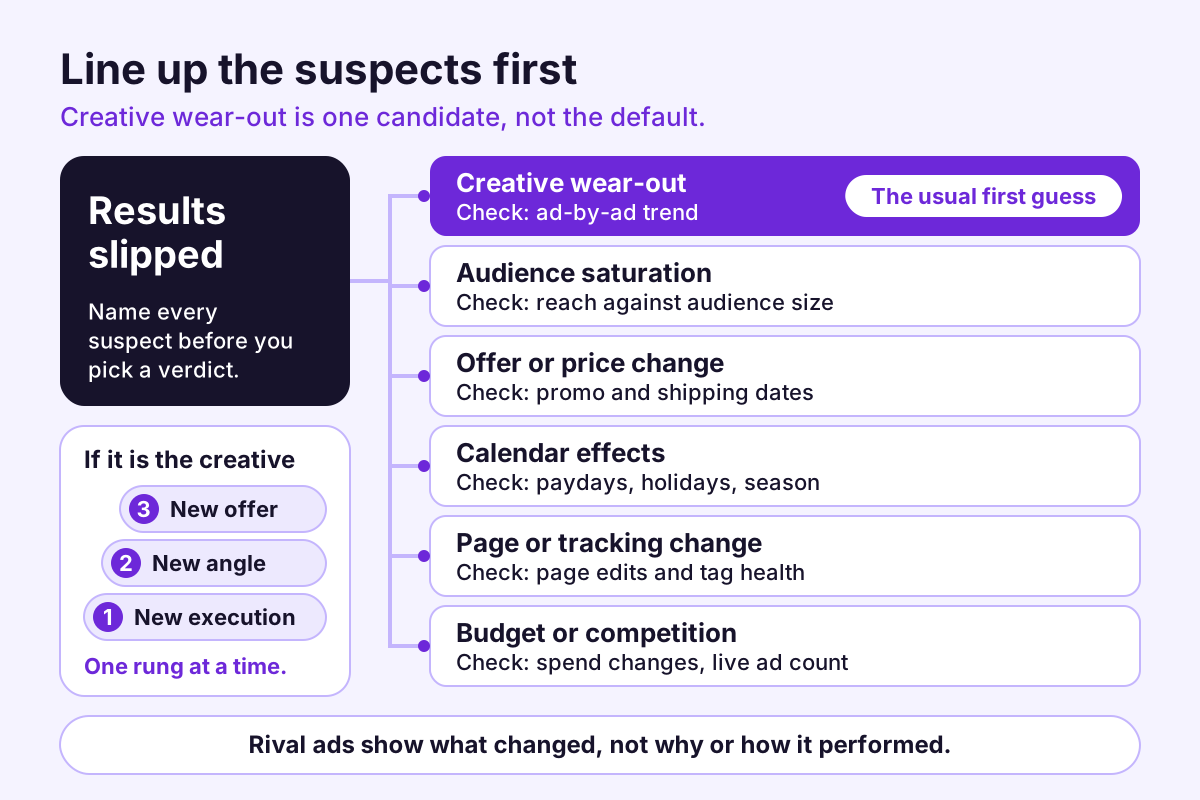
Picture a Tuesday review, invented but familiar. Cost per signup has crept up for three weeks and click-through has drifted down. Someone says what everyone was already thinking: “It’s creative fatigue.” Heads nod. A refresh sprint begins. Three weeks later the new ads post better numbers, and nobody can say why, because the offer changed, the landing page picked up a new banner and a budget moved in the same window.
“Fatigue” names something real. It is also a very comfortable place to stop thinking. This article is about keeping the word honest, and about what competitor research can and cannot tell you when results slip.
“Fatigue” is a hypothesis, not a diagnosis
Teams use “creative fatigue” for a decline they attribute to people meeting the same creative repeatedly. That is a plausible explanation. It is also one of several, and it happens to come with the most satisfying action available: make something new.
You will not find thresholds here, such as a frequency number that means “tired.” Whether a given decline is too much depends on your objective, your audience size and your measurement, and any universal figure would be invented. What follows is a way to keep the word from doing more work than the evidence supports.
Line up the suspects
Before you brief any new creative, write down what else changed. A starting list:
| Suspect | What it could look like | First place to check |
|---|---|---|
| Creative wear-out | One ad slides while a newer ad in the same set holds up | Ad-by-ad trend over identical dates |
| Audience saturation | A small audience reached again and again | Reach against audience size in your own reports |
| Offer or price change | A promotion ended or terms shifted | Your change log for offers and shipping terms |
| Calendar effects | Paydays, holidays, seasonal swings | The same stretch of last year, if you have it |
| Page or tracking change | Clicks hold while on-site results fall, or numbers jump after a tag edit | Page edits, checkout steps, tag health |
| Budget or competition | More ads splitting spend, new rivals, bid or budget edits | Spend changes and the number of live ads |
None of these excludes the others. Real accounts often have several in play, which is how a refresh ends up looking like a cure when it merely coincided with a calendar turn.
Read the shape of the decline
The shape of a slide can narrow the suspects before you collect anything new. Treat these as prompts, not rules.
- A cliff on a known date. Wear-out is usually described as a gradual process, so a sudden drop is worth checking against your change log first. A new offer, a page edit, a tracking change and a budget move all leave a date behind.
- Everything slid at once. When every ad in the account declines together, a shared cause (offer, page, season, measurement) is a more economical suspect than several ads wearing out in the same week. If only your oldest ad slid, wear-out stays on the list.
- Clicks held, results fell. When people still click but fewer finish, look past the ad: the page, the offer terms and the tracking come before the creative.
Exceptions exist in every direction. A gradual slide can be seasonal drift, and a cliff can follow a delivery change you did not log. The point is to let the pattern choose the first thing you check, not to let it hand you a verdict.
What competitor research cannot do here
Competitor research cannot diagnose your account. Public ad records show creative, not results, so they cannot tell you whether a rival’s ad has worn out, or never worked at all. Two traps follow from that.
“They have run that ad for months, so it must not fatigue.” This treats longevity as proof of performance. A long-running ad may be well funded, barely funded, forgotten, or serving a purpose you cannot see. Duration is an observation. Profitability is not.
“They retired that ad, so it must have worn out.” This assigns a cause to an absence. Ads end when promotions end, when budgets move, when products sell out. And a gap in a competitor’s records can be a partial or failed check rather than a decision on their side.
What it can do: swap the question
“Is their creative fatigued?” cannot be answered from outside. These questions can:
- When they refresh, what changes? The picture, the words, the proposition or the offer?
- How varied is their set? Many executions of one message, or many different messages?
- What does the new record ask a customer to believe that the old one did not?
Answering these questions takes record-level reading and some coverage hygiene. “Newly observed” means new to the collection in your comparison window, not necessarily newly launched, and a rise in new records can reflect more variants or a catch-up check rather than a strategic shift. Competitor tracking explains how changes are flagged, and the weekly competitor review gives you a routine for asking the questions on a schedule.
Each answer maps to a rung on the refresh ladder below. If rivals mostly vary the picture around one message, that tells you what they are changing, not what you should change. If they vary the message itself, an angle test may teach you more than another re-skin.
A refresh log row can be as plain as this: Page, window, coverage state, what stayed, what changed, what we cannot say. For example: “Page A, two weeks, complete; kept the photo and the price line; headline moved from taste to flexibility; cannot say why.” The last column is the one that keeps the log honest.
A worked example (invented)
Brand T sells a loose-leaf tea subscription. In the fourth week of a four-ad rotation, click-through is down and cost per signup is up.
Step 1: line up the suspects. The change log shows the first-order promotion ended on the 15th, the landing page gained a shipping banner on the 16th, and one of the four ads was paused. Budget did not move. The slide begins right after the promotion ended, which points at the offer at least as much as at the creative.
Step 2: ask the answerable competitor questions. You track two competitor Pages. Page A’s check is complete for the window; Page B’s is partial, so you set it aside rather than reading silence as stillness. On Page A, the newly observed records keep one product photograph but swap a taste-led headline for a flexibility-led one (“pause or skip any time”). Interpretation: they may be refreshing the argument, not the picture. You cannot know why. You can only note what changed.
Step 3: decide in your own terms. A plain re-skin is not justified yet, because the offer shift would confound it. So you restore a like-for-like comparison: your current best ad and a new flexibility-led ad, under the same offer terms, on the same page. The new ad uses your own photography and a claim you have verified, because the pause policy is real and written down. Which ad does better will be judged on your own measurement.
Step 4: say what would change your mind. If the new ad does no better than the old one under identical conditions, you do not commission a third round of creative. You move to the next suspect, here the shipping banner on the landing page, and check whether the post-click numbers moved on the 16th.
The refresh ladder
If creative is a genuine suspect, change one rung at a time. Each rung changes more, so each result tells you less about why.
- New execution. Same message and offer; different image, crop or layout. Cheapest, and it tests whether the presentation wore out.
- New angle. Same product truth, a different reason to buy. This is where creative angle research earns its keep.
- New offer or proposition. A different bundle, terms or product framing. The most expensive rung, because it involves margins, fulfillment and promises. Use your own economics; offer research covers the creative side of the comparison.
A short diagnostic checklist
- List every change in the last six weeks: creative, offer, page, budget, audience, tracking.
- Compare ads individually, not only in the account total.
- Ask whether the slide begins on a change date.
- Ask whether a new ad under identical conditions would behave differently.
- Choose the ladder rung before you brief anything.
- Phrase the competitor question as “how do they vary,” with the Page set, markets and coverage state attached.
- Decide in advance what result would make you stop refreshing.
- Save the conclusion in one breath: “We observed ____. The suspects were ____. We will test ____. We will review on ____.”
Write the refresh as a hypothesis
Here is a sentence frame to adapt: “We believe [the observed decline] may partly reflect wear-out of [creative]. If so, [new execution or angle], run under the same [offer, page and budget conditions], should [improve our chosen metric] over [window]. If it does not, we will examine [next suspect].”
The frame names the cause as a belief, fixes the conditions, and commits to a next step if the belief is wrong. It does not promise a result, and it does not borrow anyone else’s numbers as a target. A competitor’s observation count is context for your question, never a success criterion for your test.
Sources and further reading
- Ad8 competitor tracking: how changes are flagged, and why “newly observed” is not “newly launched.”
- Ad8 data coverage and research limits: partial checks, gaps and what timestamps mean.
- Ad8 creative reports: why longevity and repetition are signals to inspect, not performance scores.
- Ad8 weekly competitor review: a routine that turns observations into a small test set.
- Meta Ad Library and Meta’s help page About the Meta Ad Library: background on public ad records. Meta’s pages describe the library in Meta’s own words; Ad8 is a separate, independent service.
Turn the next observation into a better question.
See how a source-linked review separates what was observed, what it might mean, and what you could test with your own creative.
Explore the sample report