Stop Collecting Winners: Build a Creative Learning Agenda for the Next 30 Days
A folder of “winning” competitor ads cannot tell you what to test. A learning agenda turns research into three questions, three tests and decisions you set in advance.
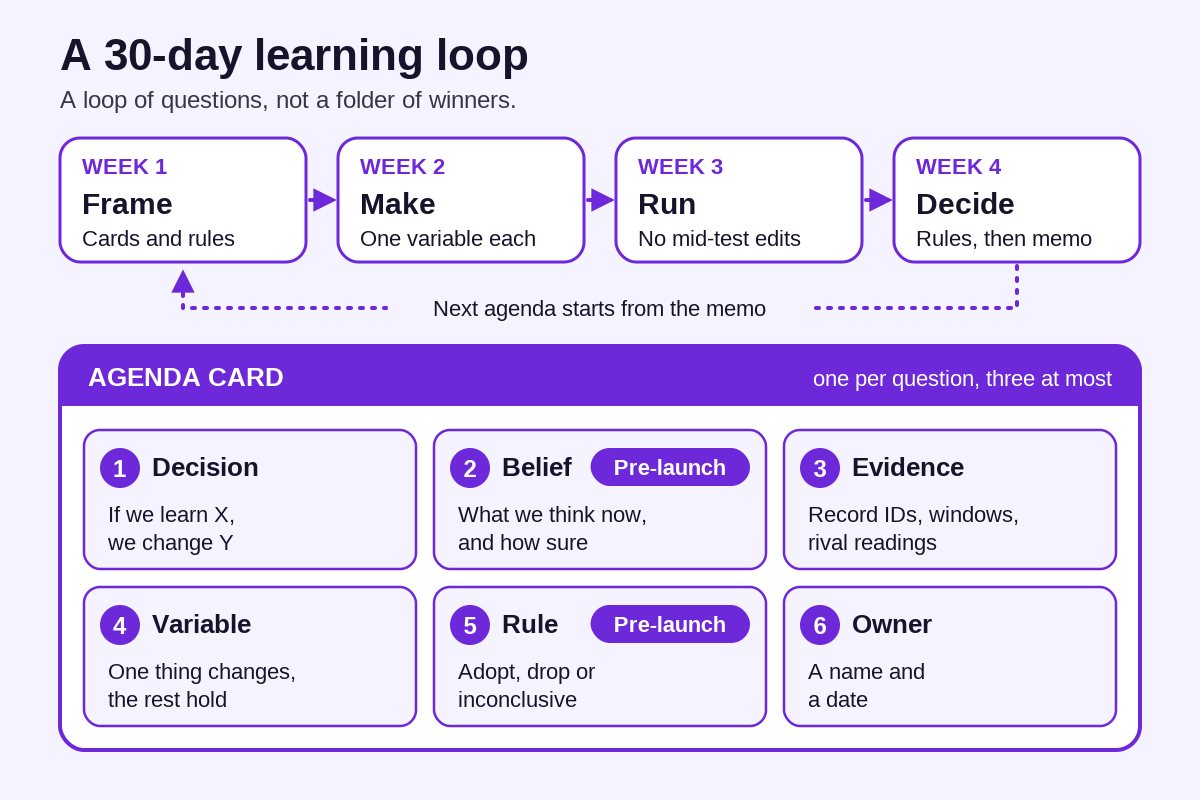
Every creative team has one: a folder, a board or a page called “Winners.” Screenshots of ads that feel like they work, saved with good intentions and visited with decreasing frequency. Filling it is satisfying. Using it is strangely hard. Open it on Monday morning and you still cannot say what to test this week.
The folder has three problems. You cannot see the results behind any ad in it. Nothing in it is attached to a decision. And it pulls toward imitation, which is neither a plan nor fully yours. The alternative is a learning agenda: a short list of questions, each paired with one test and a decision rule written before launch. What follows is editorial practice, not a proven method, so adjust it to your own team and traffic.
Why a pile of winners cannot guide a test
“Winner” is a guess. Public records of Meta ads show what an advertiser put in front of people and when a collection saw it. They do not show results. A long-running ad might have paid off, or nobody might have switched it off, or it might sit in an evergreen set. The records cannot say which. Ad8’s own FAQ is plain about this: public creative observations alone cannot identify winning ads, and reports discuss observed patterns and hypotheses. Longevity and repetition are signals worth noting, not results.
A pile has no decision attached. A reference that informs no decision is decoration. The test of a research habit is whether it changes what you do on Tuesday.
A pile pulls toward imitation. If the folder is the brief, the brief is “more like these.” That tempts a team toward another advertiser’s distinctive copy, layout or imagery, which raises rights questions and teaches you little, because you still do not know why the idea might work for your product.
The agenda card
A learning agenda is a set of cards, one per question. Here is a template you can paste into a document:
QUESTION
  One sentence a test could answer.
DECISION IT INFORMS
  If we learn X, we change Y. If we learn Z, we keep Y.
CURRENT BELIEF
  What we think now, and how sure we are.
EVIDENCE FROM RESEARCH
  Record IDs, observation windows, coverage notes.
  Rival explanations for what we saw.
THE TEST
  One variable. Everything else held constant.
  Our own assets and verified claims.
RULE, SET IN ADVANCE
  Our own metric. What counts as adopt, drop or inconclusive.
OWNER AND DATE
Two fields do most of the work. Decision it informs stops research from becoming trivia: if no outcome would change what you do, drop the question. Current belief makes you commit before you see data, so that afterward you can tell whether you learned something or merely agreed with yourself.
Pick three questions, not thirty
Start from decisions you actually face this month, not from the folder. Typical candidates are which reason to buy should lead, how an offer should be framed, which kind of image carries the product best, and which proof line deserves space. Rank them by two criteria: how much the answer would change your next batch, and whether your account can plausibly detect the difference in 30 days.
That second criterion deserves a conversation with whoever owns measurement. Ask what size of difference your traffic and budget can reliably show in a month. If the honest answer is “only large ones,” choose bolder contrasts between variants rather than subtle tweaks. Three is a ceiling, not a target.
A quick filter for candidate questions: “Which ad style is best?” fails, because it names no decision and no variable. “Should we try green?” fails, because it names a variable but no customer question. “Does naming the use case in the headline help first-time visitors understand the product?” passes. It has a decision, a variable and a person it concerns.
A worked example, invented
Brand C is a fictional reusable-bottle brand. A strategist reviews 20 static records from three tracked competitor Pages over the last 30 observed days. One Page’s check is partial. Nine records lead with a specification line, five lead with a daily-routine scene, and two mention cleaning; the categories can overlap. Here is the first card in full.
- Question: Does a routine-led headline help a first-time visitor understand the product faster than a specification-led one?
- Decision it informs: Which headline style opens next month’s prospecting batch.
- Current belief: Routine-led, with low confidence.
- Evidence: Observed: 9 of 20 records lead with specifications and 5 of 20 with routines (C-02, C-05, C-06 and others). Interpreted: specifications may simply be the category’s default way to introduce a bottle. One Page is partial, so the sample may skew. The question itself is the hypothesis.
- The test: Headline only. Same image, same offer, same landing page.
- Rule, set in advance: Adopt routine-led if it beats the control on our agreed metric by the margin agreed with measurement and the test log shows nothing that undermines the result. Drop it if it loses. Treat anything in between as inconclusive.
The other two cards, compressed:
| Question | Evidence (of 20 records) | One variable | Decision it informs |
|---|---|---|---|
| Does a one-line cleaning proof reduce hesitation? | 2 mention cleaning; absence elsewhere is not a market gap | Proof line present or absent | Whether cleaning earns space in every ad |
| Is gift framing worth its own creative? | 3 frame the bottle as a gift | Gift or personal-use headline | Whether to build a gift set of ads |
Note what the cards do not contain: no claim that any competitor ad wins, and no borrowed copy. Each cleaning or gift claim in the final ads would also need verification against the real product and packaging before launch.
The 30-day calendar
| Week | Focus | Output | Guard rail |
|---|---|---|---|
| 1 | Frame | Three cards, up to six references each | Write rival explanations and rules now |
| 2 | Make | Briefs and assets, one variable each | Verify every claim; use your own assets |
| 3 | Run | Live tests | No mid-test edits; log outside events |
| 4 | Decide | Learning memo | Apply the rules you wrote in week 1 |
Use the static ad brief template in week 2 so each test reaches a designer with its variable stated. Hold a fifteen-minute check-in when the tests go live to confirm that the variable is the only difference between variants, and another at the start of week 4 to re-read the rules before anyone looks at results. If your approval or production cycle is longer, stretch the agenda to 45 or 60 days. The calendar is a container, not a law.
Write the rules before the results
A test with no pre-agreed rule invites storytelling. If the result is good, the metric was obviously right. If it is bad, the audience was obviously wrong. Write three outcomes in week 1:
- Adopt. The variant beats the control on the agreed metric and nothing in the log undermines it. Use it in the next batch.
- Drop. The variant loses, or wins by less than it costs to keep. Retire the idea.
- Inconclusive. The difference sits inside what your account can detect. Park the idea or rerun it with a bolder contrast, and do not declare a winner.
Inconclusive is a legitimate result. It tells you the question needs a bigger contrast or more traffic. Define “beats” and the margin with the person who owns measurement, using your own data. A competitor’s record counts are not a success criterion, a point the weekly competitor review template also makes.
Five ways agendas fail
- Too many cards. Six cards means six half-finished tests. Cut to three.
- Tactics disguised as questions. “Blue versus green” is a tweak unless it is tied to a customer question.
- No owner. A card without a name on it is a wish.
- Mid-test edits. Changing copy in week three turns two variants into four. Log outside events instead of reacting to them.
- Reruns without changes. An inconclusive result repeated at the same contrast tends to return the same shrug. Change the contrast or change the question.
Keep a kill list and a parking lot
Some ideas should not make the agenda. Put them on a kill list with a one-line reason: the idea needs a claim you cannot support, depends on someone else’s assets or likeness, changes several variables at once, cannot be measured, or reproduces another advertiser’s distinctive copy or layout.
Ideas that are good but not now go to a parking lot, each with its evidence note: record IDs, windows, coverage state. A parking lot is where good ideas wait. A graveyard is where they are forgotten, and the evidence note is what keeps the difference.
The monthly learning memo
At the end of the month, write one page:
LEARNING MEMO
What we believed: ___
What we ran: ___ (variable, dates, assets)
What happened, in our own data: ___
What we believe now, and how sure we are: ___
What we will test next: ___
What research we need next: ___
Then prune your reference set. Keep the records that still serve an open question, and archive the rest. The next agenda should start from this memo, not from the folder.
Sources and further reading
- Ad8, Creative reports with ad evidence: separating observations, interpretations and test hypotheses.
- Ad8, Sample creative intelligence report: a fictional example ending in original test briefs.
- Ad8, Static ad creative brief template: turning a reference into an original direction.
- Ad8, Weekly competitor creative review: a seven-step review that ends in a decision.
- Ad8, Frequently asked questions: what public ad records can and cannot show.
- Ad8, Data coverage and research limits: observation dates, coverage states and counts with denominators.
- Meta Business Help Center, About the Meta Ad Library: Meta’s description of the public library.
- Meta Ad Library: the public source for checking an ad record yourself.
Turn the next observation into a better question.
See how a source-linked review separates what was observed, what it might mean, and what you could test with your own creative.
Explore the sample report